2026-08-14
Start with the real input list
Count every microphone, instrument, playback device and spare input needed for the job before choosing a console. An eight-input analog mixer can suit speech systems, rehearsal rooms, small worship spaces and compact rental packages, while larger productions need additional mono inputs and more room for future expansion. Do not choose by channel number alone: confirm how many inputs are mono microphone channels and how many are stereo returns or media inputs.
Decide how much processing the operator needs
A professional analog mixer with DSP can reduce the amount of external rack equipment required. Useful live-sound tools include channel EQ, a master graphic EQ, effects, compression and feedback control. A 15-band graphic EQ helps shape the overall system, while onboard DSP effects cover common vocal and music applications. The controls should remain easy to reach so an operator can respond quickly during a performance.
Compare fader travel and control speed
Fader length affects how precisely an operator can make small level changes. Compact mixers often use short faders to save space, while professional consoles with 100 mm logarithmic faders provide more physical travel for detailed balancing. Long-throw faders are especially useful when several microphones must stay close in level or when the mix changes throughout an event.
Check routing, monitor sends and recording
Review the number of groups, AUX sends, stereo returns and main outputs against the system plan. Monitor mixes, external effects, recording feeds and zone outputs all consume routing resources. If computer recording is part of the workflow, confirm the USB interface specification instead of assuming that a USB media port carries multichannel or high-resolution audio.
Verify microphone power and connection formats
Condenser microphones and active direct boxes may require +48 V phantom power. Buyers should also confirm the available XLR and TRS connections, main output format, power requirements and rear-panel layout. Clear product photos, a complete parameter table and a downloadable specification sheet make it easier to compare suppliers and avoid surprises during installation.
Where the MICKLE RA PRO Series fits
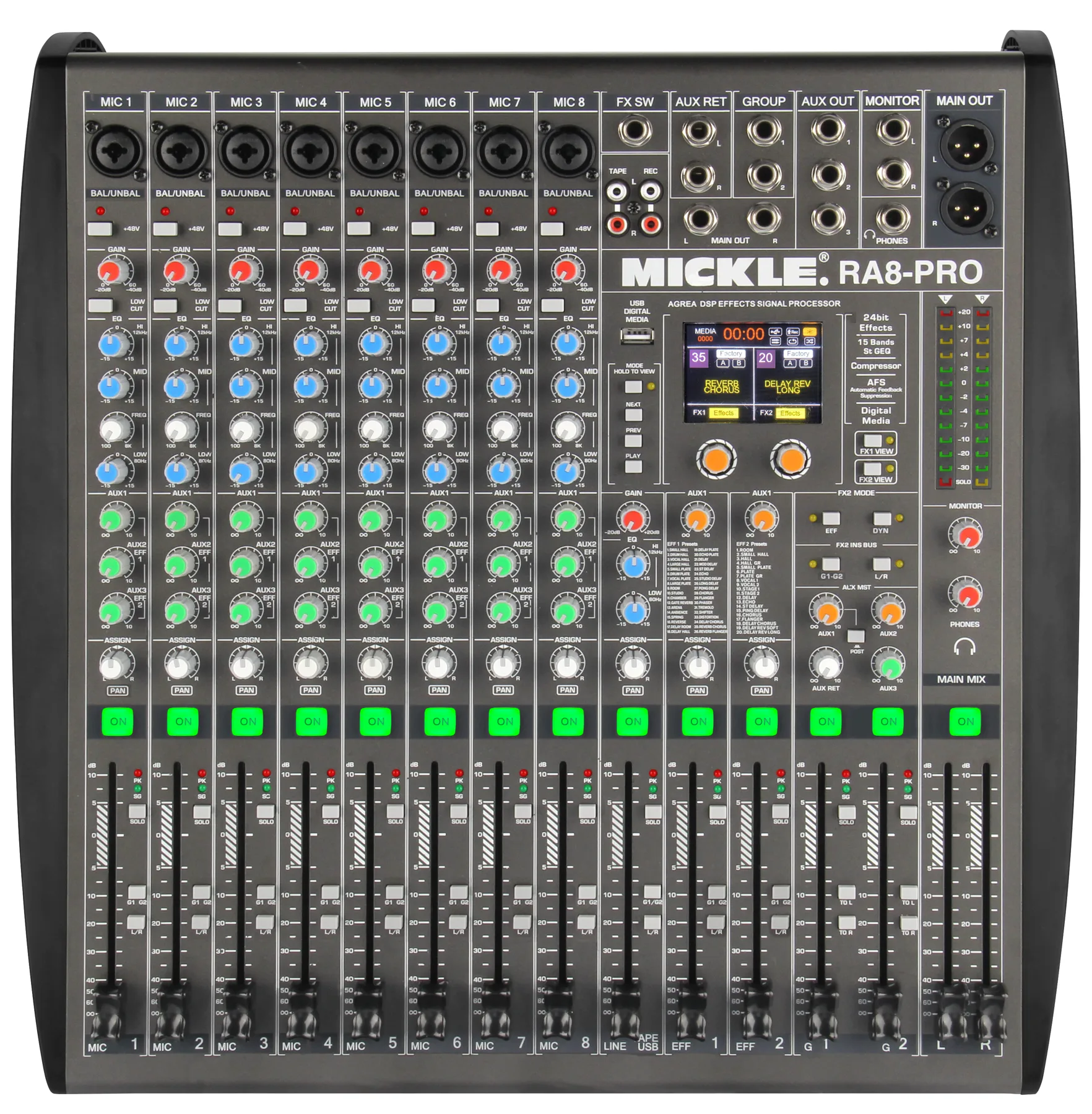
The MICKLE RA PRO Series is available in 8, 12, 16 and 24 mono-input formats. The platform combines dual 24-bit DSP, a 15-band graphic EQ, compression, automatic feedback suppression, 100 mm faders, +48 V phantom power and an independent 24-bit / 192 kHz USB recording interface. It is designed for live venues, houses of worship, rental systems, installed audio and qualified OEM or ODM projects that need direct analog operation with integrated digital tools.
Related mixer resources
Explore the MICKLE RA PRO Series
Review RA8-PRO and RA PRO features, available input formats, product images and technical parameters.
Browse professional analog mixers
Compare additional mixer formats for live sound, rental systems and fixed installations.
Discuss an OEM or ODM mixer project
Share the channel format, target market, application and expected order quantity with the MICKLE AUDIO team.